Hallmarking
The marks inside the band
Describing an article as gold, silver, platinum or palladium in the United Kingdom, above certain weights, without it being hallmarked is a criminal offence under the Hallmarking Act 1973. This page sets out what that means for what we sell.
Reading a hallmark
A UK hallmark is a row of small punched marks on the inside of the band. Three of them are compulsory and two more are optional.
- 01
The sponsor's mark
Initials in a shaped surround, identifying the firm that submitted the article for testing. Registered with the assay office and unique to that firm.
- 02
The fineness mark
A number in a shaped surround giving the parts per thousand of precious metal. 375 is 9ct gold, 750 is 18ct gold, 950 is platinum. The shape of the surround tells you which metal it is.
- 03
The assay office mark
Which of the four British assay offices tested it. A leopard's head is London, an anchor Birmingham, a rose Sheffield, a castle Edinburgh.
- 04
The date letter
Optional since 1998. A letter in a shaped shield giving the year of testing.
- 05
The traditional fineness symbol
Optional. A crown for gold, an orb for platinum, and so on, carried over from the older system.
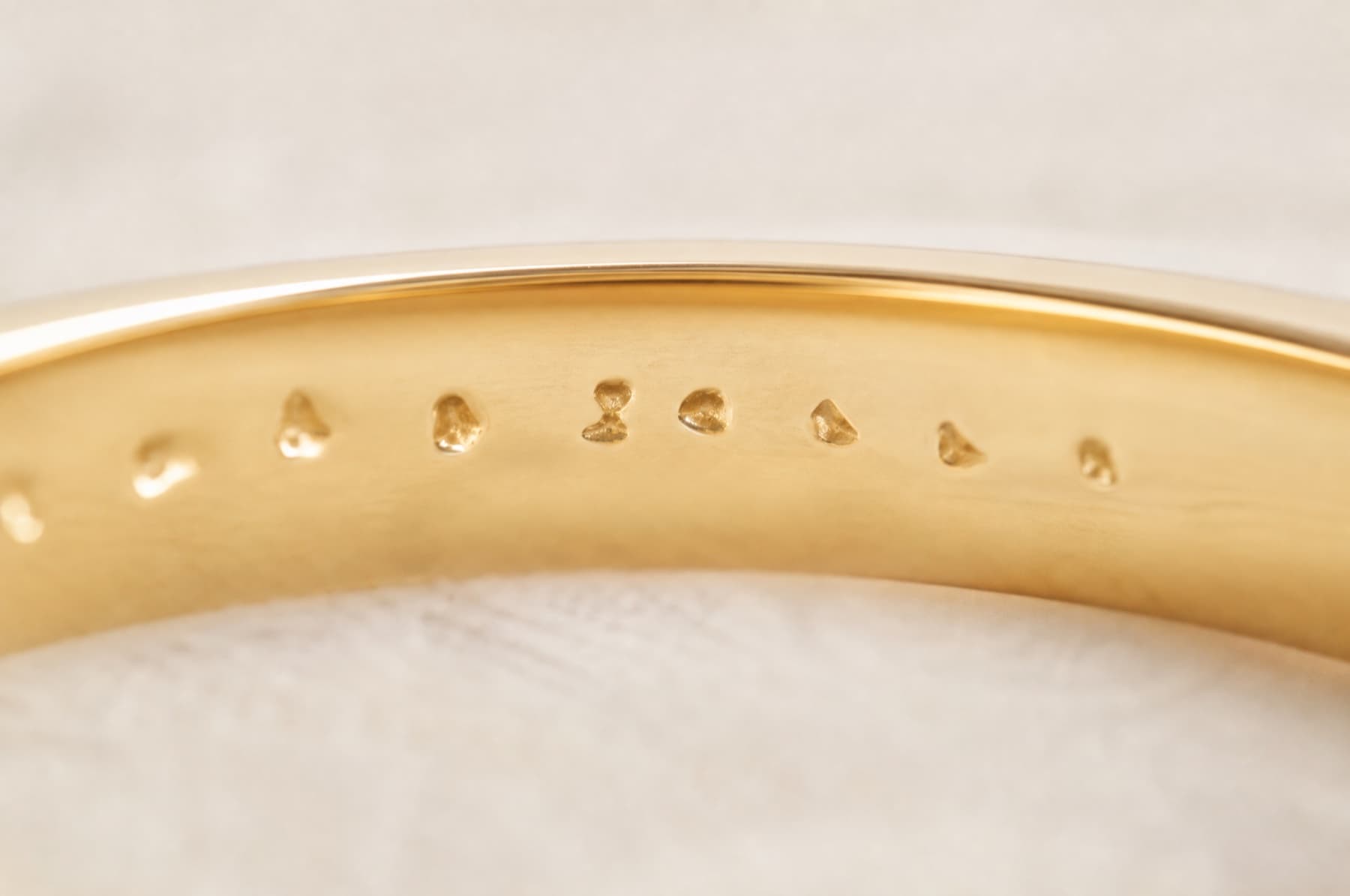
The marks are small. On a 2 mm band they are barely visible without a loupe, which is normal and is not a sign that anything is wrong.
The statutory exemption weights
Below these weights of precious metal, an article need not be hallmarked. Above them, it must be, before it can lawfully be described as that metal.
| Metal | Exempt at or below |
|---|---|
| Silver | 7.78 g |
| Gold, any carat | 1 g |
| Platinum | 0.5 g |
| Palladium | 1 g |
A wedding ring is nowhere near any of those figures. The lightest ring in this range is 1.8 g of 9ct gold and the heaviest is 8.4 g of platinum. Every precious metal ring we sell is therefore over the exemption and every one of them carries its marks.
What is struck on our rings
| Metal | Pieces | Net weight range | Exemption | Hallmarked |
|---|---|---|---|---|
| 9ct gold | 2 | 1.8 to 2.6 g | 1 g | All |
| 18ct gold | 25 | 2.9 to 9.4 g | 1 g | All |
| Platinum 950 | 11 | 4.8 to 8.4 g | 0.5 g | All |
The assay office and net weight for each individual ring are printed on its own product page. The shop is built so that a precious metal item over the exemption weight with no hallmark recorded against it is withheld from the shop floor rather than listed.
Dealer's Notice
Statutory notice
United Kingdom hallmarks and the approved marks of the Convention
It is an offence for any person in the course of a trade or business to describe an unhallmarked article as being wholly or partly made of gold, silver, platinum or palladium, or to supply such an article to which such a description is applied.
The compulsory marks on a United Kingdom hallmark are the sponsor’s mark, the assay office mark and the fineness mark, expressed in parts per thousand. The standards of fineness recognised in the United Kingdom are:
- Silver: 800, 925, 958, 999
- Gold: 375 (9ct), 585 (14ct), 750 (18ct), 916 (22ct), 990, 999
- Platinum: 850, 900, 950, 999
- Palladium: 500, 950, 999
Marks struck by an assay office of a state party to the International Convention on Hallmarks, bearing the Common Control Mark, are recognised in the United Kingdom on the same footing as United Kingdom marks.
Certain articles are exempt from hallmarking by reason of their weight, as set out in the table above, or by reason of their age where they were manufactured before 1950.
What resizing does to a hallmark
An existing hallmark remains valid after an ordinary resizing. The marks are on a part of the band that is not usually cut, and moving a ring one or two sizes does not change what it is made of.
Where a ring is altered substantially — a large change of size, or the addition of a meaningful quantity of metal — the article can no longer be relied upon as being the one that was tested, and it must be sent back to an assay office to be re-tested and re-marked. If work of that scale is ever needed on a ring bought here, we will say so before starting rather than afterwards.
If the marks on your ring are ever damaged or worn to the point of being unreadable, an assay office can examine and re-mark the article. Ask us and we will arrange it.