Declarations
What we are selling, said plainly
This page exists because the diamond trade has spent a century making this subject harder to understand than it needs to be. Everything below is the position this shop takes, and every product page is written to match it.
A natural diamond and a laboratory-grown diamond are the same material: the same chemistry, the same hardness, the same optical behaviour. They differ in how they formed and in what the market charges for them. Both are shown here with the same specifications and the same photograph, and this shop takes no position on which you should choose.
The four materials, defined
Four things get sold as the stone in a ring. They are not interchangeable and this shop names each of them for what it is.
- Natural diamond
- Carbon crystallised under pressure and heat deep in the earth over a geological timescale, then brought near the surface by volcanic activity and mined. Every natural stone sold here is described as a natural diamond and nothing else.
- Lab-grown diamond
- Carbon crystallised under pressure and heat in a reactor, over weeks rather than aeons, by one of two processes: high pressure high temperature, or chemical vapour deposition. The result is diamond. Same chemistry, same crystal structure, same hardness of 10 on the Mohs scale, same refractive index. A laboratory can tell the two apart by looking at growth patterns and trace elements; a jeweller with a loupe generally cannot, and neither can an eye.
- Moissanite
- Silicon carbide, not carbon. A different mineral with a different hardness and noticeably more fire than diamond. It is a stone in its own right and we call it moissanite. We do not sell it as any kind of diamond and we do not use the phrase moissanite diamond, which is a contradiction.
- Cubic zirconia
- Zirconium dioxide. A simulant: it is made to resemble diamond and is not related to it. Softer, heavier, and distinguishable by eye once you know what to look for. Never described here as a diamond.
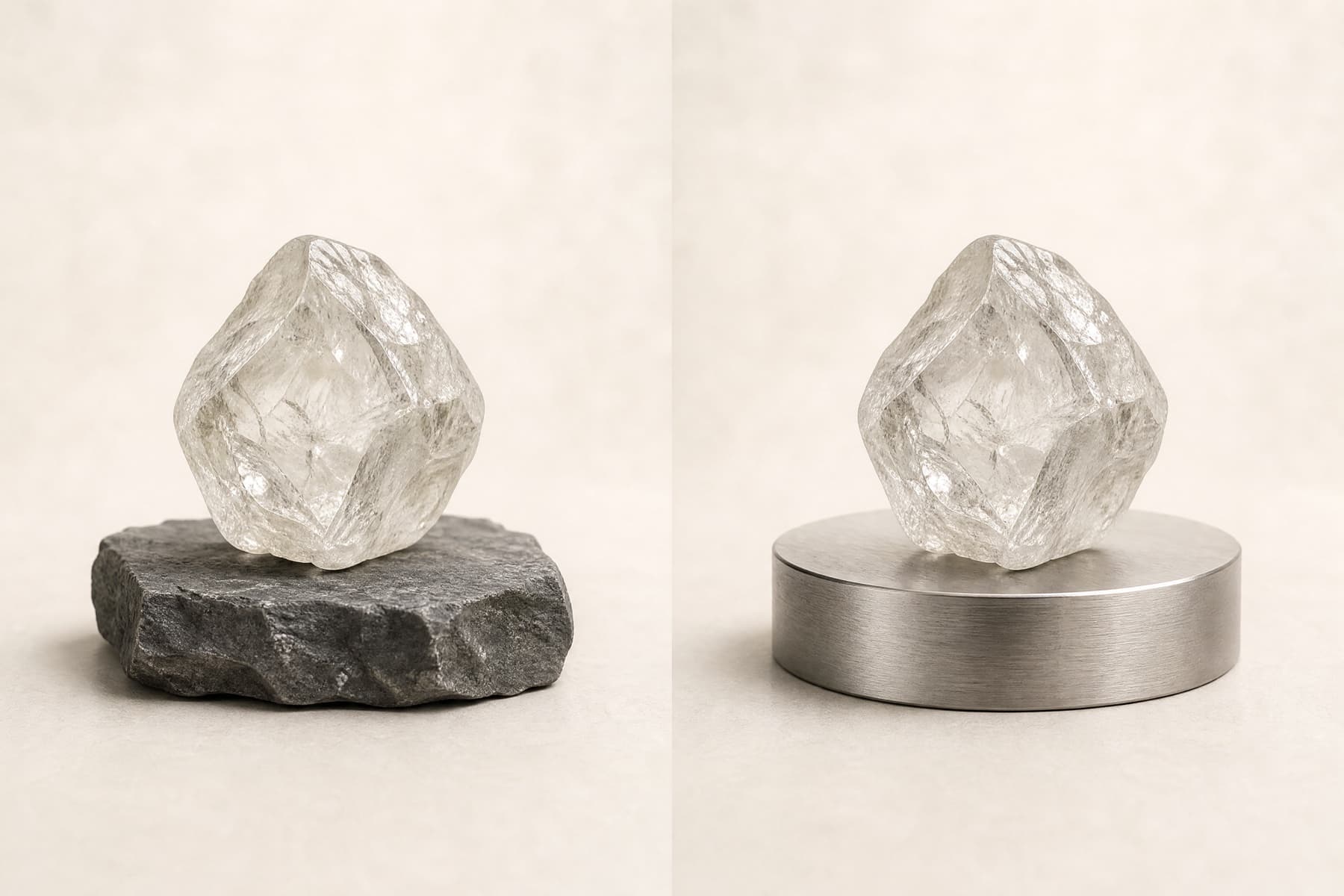
Both halves of that photograph are lit and framed identically, which is the same rule the product photography follows.
How the two are told apart
Not by eye, and not by a jeweller’s loupe. The differences are in growth structure, in fluorescence patterns under particular wavelengths, and in trace elements — nitrogen in most natural stones, sometimes metallic flux in high pressure high temperature stones. Detecting them takes laboratory instruments.
This is precisely why the declaration matters. If the difference could be seen, disclosure would be optional. Because it cannot, disclosure is the whole basis on which the stone can honestly be sold. Every stone on this site carries its origin as a required field, and the shop is built so that a piece with no declared origin does not appear on the shop floor at all.
Reports, and where they stop
Any centre stone of 0.30 ct or more is sold with a report from an independent gemmological laboratory, named in full on the product page. Below that weight, and for multi-stone pieces with no centre stone, no report is issued and no colour, clarity or cut grade is quoted — because there would be nothing behind the grade. A report describes a stone; it is not a valuation and not a guarantee of anything.
Natural stones here are reported on by the Gemological Institute of America and lab-grown stones by the International Gemological Institute. Both are independent laboratories and both report on both kinds of stone; the split simply follows which laboratory the respective supply chains work with. It carries no implication about which stone is better.
A report number is printed on the product page. Until a stone is allocated to an order the number shown is a placeholder, and the ring you receive comes with a report carrying its own unique number that can be checked on the issuing laboratory’s public database. The report travels with the ring, and a return has to include it.
The 4C, and what each one is worth knowing for
- Carat
- Weight, not size. One carat is 0.2 grams. Two stones of the same carat weight can look different sizes depending on how they are cut.
- Colour
- Graded D to Z, from colourless downwards, describing how little tint the stone has. The difference between adjacent grades is very hard to see face-up in a mounted stone.
- Clarity
- How few inclusions the stone contains, graded from flawless down through VVS, VS, SI and I. From VS2 upwards, inclusions are not visible to the eye.
- Cut
- How well the stone has been proportioned and finished, which governs how it handles light. A cut grade is only issued for round brilliants; fancy shapes such as oval and cushion are not given one, and we do not invent one for them.
Grades appear on a product page only where a report supports them. On the cluster ring and the multi-stone bands you will find no grades at all, because no independent report is issued for those stones and a grade without a report behind it is an assertion, not information.
Total carat weight is not stone size
Total carat weight is the weight of every stone in a piece added together. A band listed at 0.40 ct total might hold twenty stones of 0.02 ct each. It says nothing at all about the size of any individual stone, and it is never used here in a way that suggests it does. Where a piece has a centre stone, that stone's own weight is listed separately from the total.
This is the most common way a jewellery listing misleads without saying anything untrue. A band advertised as “0.75 carat” sounds like it holds a three-quarter carat stone. It might hold thirty small ones. On this site the total is always labelled as a total, and a centre stone always has its own line.
Language this shop does not use
The phrases below turn up throughout the trade. Each of them is either misleading, unsubstantiable or designed to apply pressure. None appears anywhere on this site, and the build fails if one ever finds its way into a page, a product description or a published customer review.
- A real diamond, a genuine diamond, an authentic diamond
- Used as a contrast with laboratory-grown stones, these words imply that a lab-grown diamond is a fake. It is not. It is diamond. The Advertising Standards Authority takes the same view, and so does the international gemmological trade body.
- Moissanite diamond
- Moissanite is silicon carbide. Attaching the word diamond to it misdescribes the material.
- Identical to natural, at a third of the price
- The reverse fault. It talks down a natural stone in order to sell a lab-grown one. We do not argue in either direction; the table sets the two out and the choice is the customer's.
- An investment, holds its value, appreciates
- Retail jewellery is a purchase, not an asset. What a ring costs in a shop and what it fetches second-hand are very different numbers. Suggesting otherwise would be misleading.
- Two months' salary
- An advertising slogan from the 1930s, pressed into service ever since to make people spend more than they meant to. It is pressure advertising and the CAP Code restricts it.
- Never comes loose, guaranteed to fit, lifetime guarantee
- None of these can be honoured. Settings need checking, fit cannot be promised remotely, and we only undertake what is written into the terms.
- Hypoallergenic
- Not a permitted description for jewellery and not a measurable one. What can be stated, and is, is that nickel release is tested to UK REACH limits.
On value
We make no claim about what any ring here will be worth later, to anyone. The gap between a retail price and a second-hand price in this trade is wide, in both origins, and a shop that implies otherwise is selling you a story rather than a ring.
The prices on this site are what the rings cost to buy today, in pounds sterling, with VAT included. That is the only financial statement we make.
Materials we do not deal in
No ivory, in any form and of any age, in line with the Ivory Act 2018. No material from any species listed under CITES. Nickel release on everything sold here is tested to the UK REACH limit of 0.5 micrograms per square centimetre per week for prolonged skin contact, with lead and cadmium within the same regulation’s limits.
If something on this page is unclear, or you think we have got something wrong, write to us. Contact